On this page
Overview
When to change chords in relation to the lyrics?
By convention, in a traditional chords sheets, the chords are located on an empty line above the lyrics. And the position of a chord above the text indicates the precise moment of the chord change.
Let’s take an example:
       Em                  D
On the first part of the journey
      Em                   D
I was looking at all the life
           Em                     D
There were plants and birds and rocks and things
          Em                   D
There was sand and hills and rings
    Em                      D
The first thing I met was a fly with a buzz
        Em              D
And the sky with no clouds
    Em                   D
The heat was hot and the ground was dry
        Em                 D
But the air was full of sound
Now, take a look at the corresponding one-pager section:
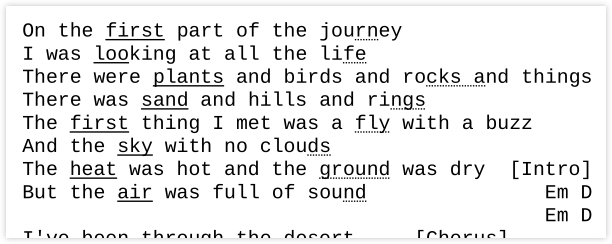
As you can see, the connection is pretty simple:
| Type of underline | Meaning |
|---|---|
| Standard a.k.a. solid underline | Chord change for the first measure of the line |
| Dotted underline | Chord change for the second measure of the line |
The position of the underline matters quite a lot
An underline could be positioned in three different ways:
| Position of the underline | Meaning |
|---|---|
| An entire syllable is underlined | The chord change is precisely aligned with the beginning of that syllable |
| The underline is at the intersection between two syllables | The chord change happens after the beginning of the first syllable and but also before the beginning of the second syllable |
| Only the end of the last syllable of the line is underlined | The chord change happens after the beginning of that last syllable but also before that syllable is over |
In our previous example:
- These chord change is aligned with these syllables:
first,loo,plants,sand,first,fly,sky,heat,ground,air - The chord change happens in between those two syllables:
jourandney,rocksandand - The chord change happens after these syllables start and before they end:
life,rings,clouds,sound
Tip
If this is still a bit confusing, don’t hesitate to listen to the song and tap the tempo with your fingers (e.g. 1, 2, 3, 4, 1, 2, 3, 4, …). This should help you understand why the chords and the lyrics are aligned this way 😊