⁉️ How to read a one-pager
I can’t find my way around the page, please help!
Don’t despair! Hopefully, most of what’s coming next will feel pretty much intuitive 😎
Tip
The easiest way to grasp the structure of a one-pager is simply to listen to the song and read along!
And remember, the whole purpose of these one-pagers is to make the font size as big as possible by optimizing how the information is arranged on the page. The One-Pager Chords system is entirely based on that philosophy.
In any case, if you’re still not satisfied with a one-pager PDF, feel free to make your own edits 🚀
One-pagers, at a glance
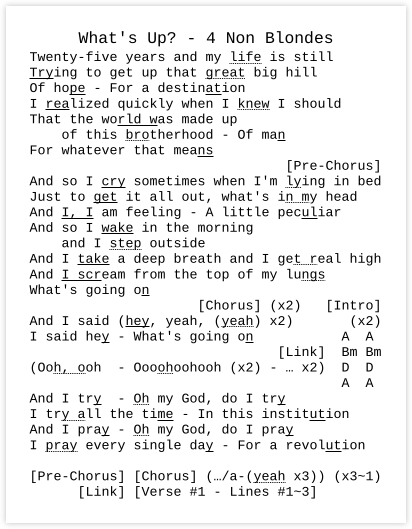
A one-pager is structured in sections defined by name tags, e.g. [Intro], [Chorus], etc. Sections can be re-used later on. Usually, verses don’t have a name tag. A section can be repeated multiple times, e.g. [Chorus] (x2).
The chords to play for a given section are located beside its name tag. Some sections (especially verses) often don’t have chords attached, usually because they use the same chords as the [Intro] section.
The duration of one chord is one measure (a.k.a. one bar)—e.g. 4 strokes in 4/4 time signature. When there’s a chord change within the same measure, the two chords are separated by a -—e.g. A-D, i.e. 2 strokes each.
Each line of lyrics is associated with a pair of chords, i.e. two measures. Chords are often grouped by groups of 4 chords—i.e. two lines of lyrics—separated by - . Groups can be repeated multiple times, e.g.:
(F F C C - Dm Dm F C x3) - F F C C - Dm Dm A A
Two lines of lyrics combined on the same line are separated by - . When a line of lyrics spans over two lines, the second line starts with 4 spaces. … means an empty line, i.e. two measures.
Chord changes are represented using underlines:
| Type of underline | Chord change |
|---|---|
| Standard | First measure of the line |
| Standard bold | Second chord of the first measure (e.g. A-D) |
| Dotted | Second measure of the line |
| Dotted bold | Second chord of the second measure (e.g. D-E) |
All these concepts—and more!—are explained in details in the next chapters.
🤷 What about these strange signs: (…), /, ~, etc.?
Out of all the One-Pager Chords strategies to optimize the content in the page, this is certainly the most advanced. We will cover it at the very end of this chapter in 🔓 Unlocking the power of substitutions and repetitions.
Where is the title of the song?
The artist and title usually sit at the top of the page. However, they’re sometimes concealed somewhere else in the page in order to leave more room for the content. In that case, you will find them enclosed in a little box, e.g.:
╔═══════════════════════╗
║    Californication    ║
║ Red Hot Chili Peppers ║
╚═══════════════════════╝
Sometimes, the title and the artist can be split between two separated boxes, e.g.:
╔═══════╗
║ Sunny ║
╚═══════╝
…
╔══════════╗
║ Boney M. ║
╚══════════╝