…so that it can be re-used
If a section repeats again later on, it will be referred to only by its name tag (e.g. [Chorus]) –unless some of its content is different. In other words, every time a section name tag is hanging by itself somewhere in the page, that means you should play that section again.
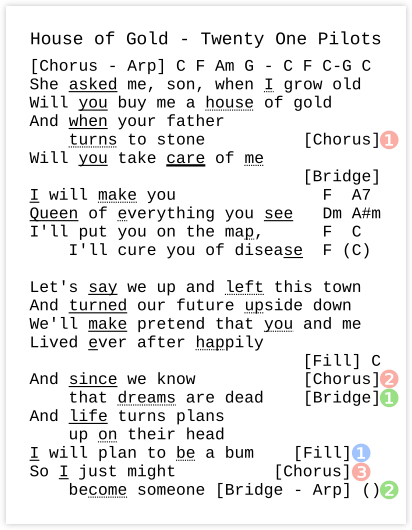
Let’s take a look at the previous example:
- the
[Chorus]section (in red) is re-used 3 times - the
[Bridge]section (in green) is re-used twice - the
[Fill]section (in blue) is re-used once - none of the Verses are re-used
What if there’s a number in the name tag?
From time to time, you might see sections with a number in the name tag (e.g. [Chorus #2], [Verse #1]). These sections might be re-used later on and the number is simply a way to indicate which one specifically we’re referring to.
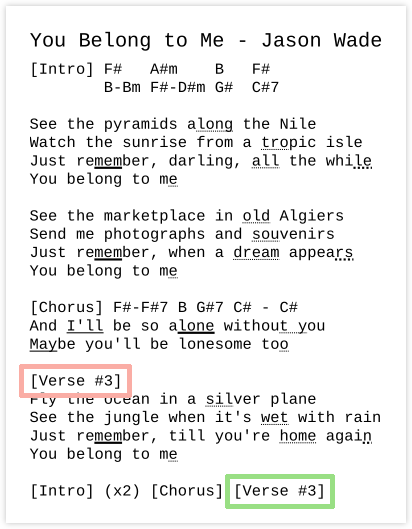
In the example below, the section [Verse #3] is first defined (in red) and then re-used (in green). Its section number ensures it won’t be confused with the other Verses.
A name tag can be split on two lines with a hyphen
Something else you might see is a section whose name tag is hyphenated—i.e. split in two with a -—and spans over two lines (e.g. [Cho- on one line and rus] on the next or [Ver- and se]). Similarly, for a numbered section, the name and the number might split be on two lines (e.g. [Chorus and #2]).
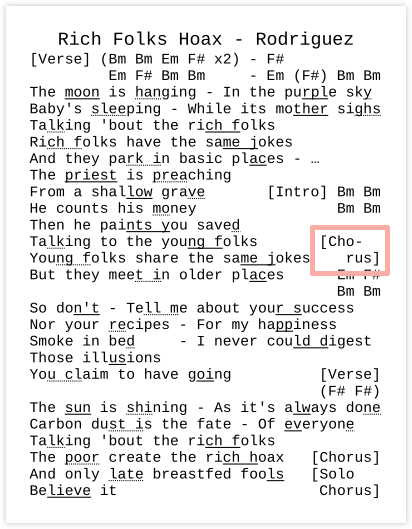
In this example, the name of the [Chorus] section is hyphenated (in red).
An unusual scenario: a section with no name tag—but it’s not a verse!
Pretty rarely, sections other than Verses might also not have a name tag. When that’s the case, it’s usually because the song structure is quite regular (e.g. Verse, Chorus, Verse, Chorus) and the lyrics of each section differ from the previous ones. It should therefore be obvious which section these unnamed sections refer to in terms of chords.
For instance:
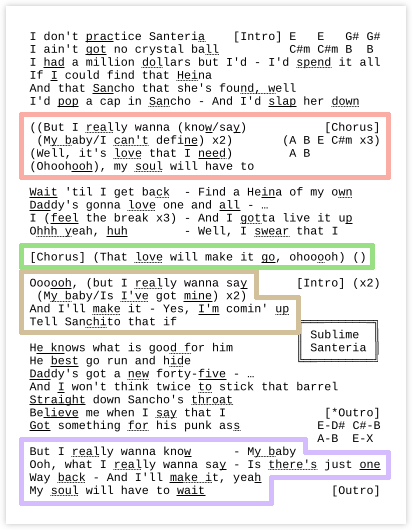
In the above example, not only the sections for the Verses don’t have a name tag, but also 2 out of the 4 [Chorus] sections. Let’s break it down from the top:
- The song start with an instrumental
[Intro]section - Followed by the first Verse
- Then the
[Chorus]section is defined (in red) - Followed by the second Verse
- The
[Chorus]section is then re-used a first time (in green)- If you wonder what these
(and)signs mean, check out the segment about substitutions
- If you wonder what these
- Notice the
[Intro]section played twice after the second[Chorus]: musically speaking, it’s a Verse without lyrics - That “instrumental Verse” is then followed by a Chorus (in brown) without a
[Chorus]section indicator - Followed by the third Verse
- Followed by another unnamed Chorus (in purple)
- And finally the
[Outro]section- If you wonder what the other
[*Outro]section means, it’s just where the chords of the[Outro]section are defined
- If you wonder what the other